What Is Post-Purchase Data, and Why Are FMCG Brands Ignoring Their Best Source of It?
What Is Post-Purchase Data, and Why Are FMCG Brands Ignoring Their Best Source of It?
Here’s a stat that should bother every brand manager in FMCG: in-store purchases still represent around 85% of grocery sales globally. That’s the overwhelming majority of your revenue. Yet, for most brands, the people making those purchases are completely invisible.
If you sell online, you know everything. Name, email, browsing history, basket contents, how often they buy, what made them leave. If you sell through retail, you know almost nothing compared to online customers.
The biggest source of first-party data most FMCG brands will ever have is already sitting on their shelf. They’re just not collecting it.
Key Takeaways
- In-store accounts for ~85% of FMCG grocery sales, yet most brands capture zero first-party data from these customers (Econ Market Research, 2026)
- Connected packaging turns the product itself into a data capture channel, not just a marketing surface
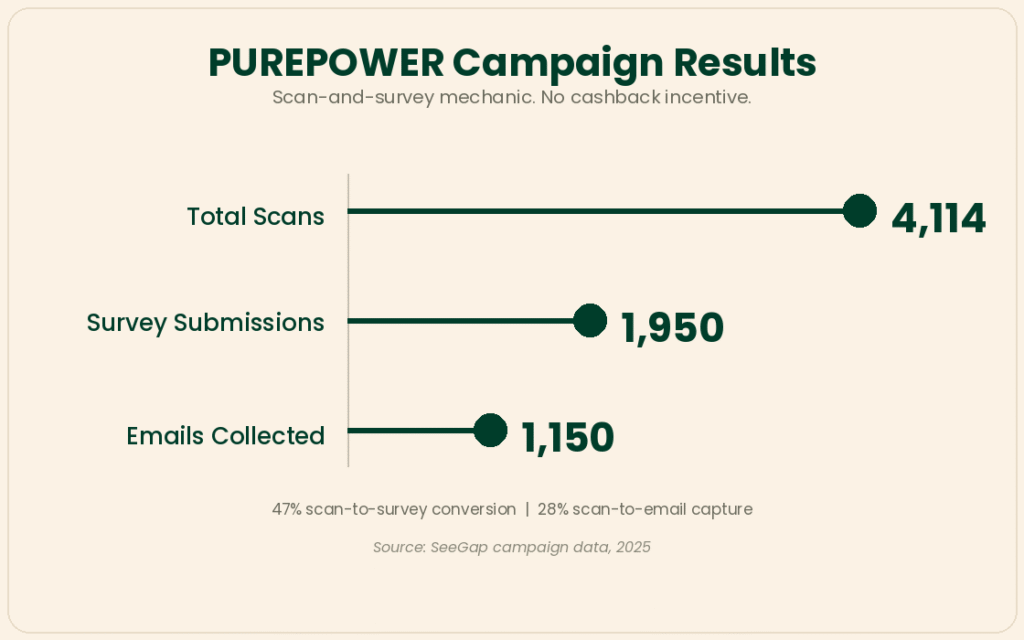
- PUREPOWER collected ~1,100 verified consumer emails from a single on-pack campaign with no cashback spend
- Brands building first-party retail data now will have a structural advantage as third-party tracking continues to erode
Why Do Brands Know Everything About Online Customers and Nothing About Retail Ones?
In Q1 2025, 71% of publishers recognised first-party data as a key source of positive advertising results, up from 64% the year before.
85% expect its importance to increase further in 2026 (Adtelligent, 2025). The direction is clear: first-party data isn’t optional any more. But here’s the problem for FMCG brands: most of the conversation about first-party data assumes you have a website, an app, or a DTC channel where customers log in and browse.
What if your product is bought off a shelf in Tesco?
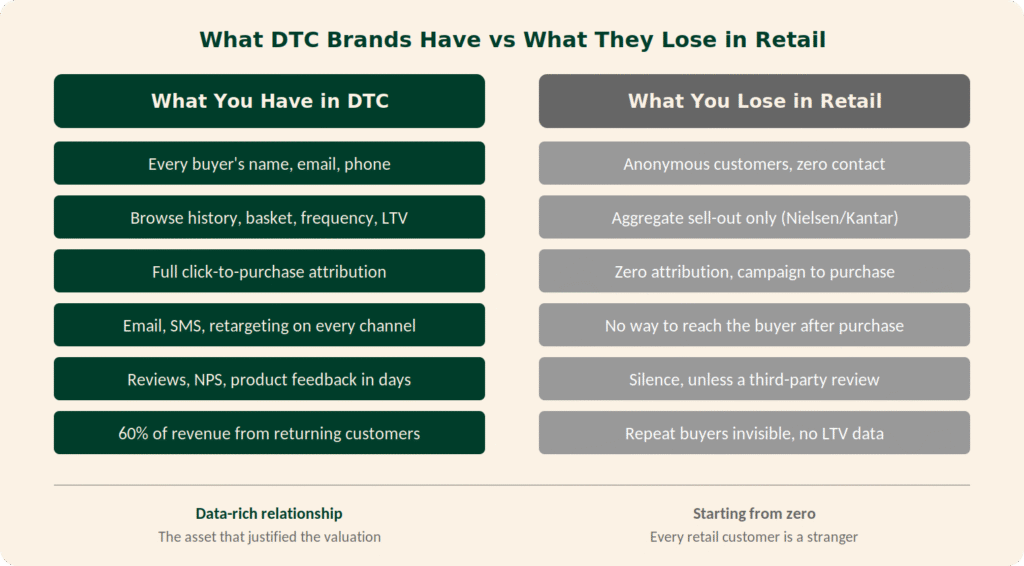
The gap between what brands know about their online customers and their retail customers isn’t small. It’s a chasm. Online, you get granular, individual-level data on every interaction.
Retail gives you barely any of that. You get backward-looking, aggregated, sampled data that tells you roughly what happened in a category. Not who your customer is, why they bought, or whether they’ll come back.
What we see: Every brand we speak to has the same reaction when we lay this out. They know it intellectually, but they’ve never seen the gap mapped side by side. The moment they do, the question changes from “why would we do this?” to “why haven’t we done this already?”
This isn’t a data strategy problem. It’s a structural one. And it’s been accepted as normal for so long that most brands don’t even question it.
What Is Post-Purchase Data, and Why Does It Matter More Than You Think?
The smart packaging market is projected to grow from $26.3 billion in 2025 to $40.8 billion by 2035, according to Future Market Insights. That growth isn’t being driven by novelty. It’s being driven by brands realising their packaging can do something it’s never done before: collect data.
Post-purchase data falls into two layers. The first is interaction data: when someone scanned, where they were, what device they used, how long they engaged. This is the data that gets generated automatically when a consumer interacts with your packaging.
The second layer is more valuable. It’s declared first-party data: the information a consumer gives you voluntarily. Their email address. Their name. Their survey responses. Their product preferences. Their feedback. This is the data that turns an anonymous retail transaction into a relationship.
Here’s why post-purchase matters. The consumer has already bought. They’re holding your product. They’re at peak engagement with your brand. This isn’t a cold prospect scrolling past an ad. It’s a verified buyer at the moment of maximum receptiveness.
And yet, the vast majority of QR codes on packaging today send people to a recipe page or a static landing page that captures nothing. As Appetite Creative’s research found, well-placed QR codes with strong calls-to-action can achieve 7-8% scan rates, while poorly positioned ones drop below 0.5% (Food Navigator USA, 2025).
How Does Connected Packaging Actually Capture This Data?
According to Appetite Creative’s 2026 Global Connected Packaging Survey, 73.2% of respondents scored 4 or 5 out of 5 for interest in serialised QR codes for personalised engagement and fraud prevention, a 7.1 point increase from 2025 (Appetite Creative, 2026). Interest is accelerating, but execution still lags behind.
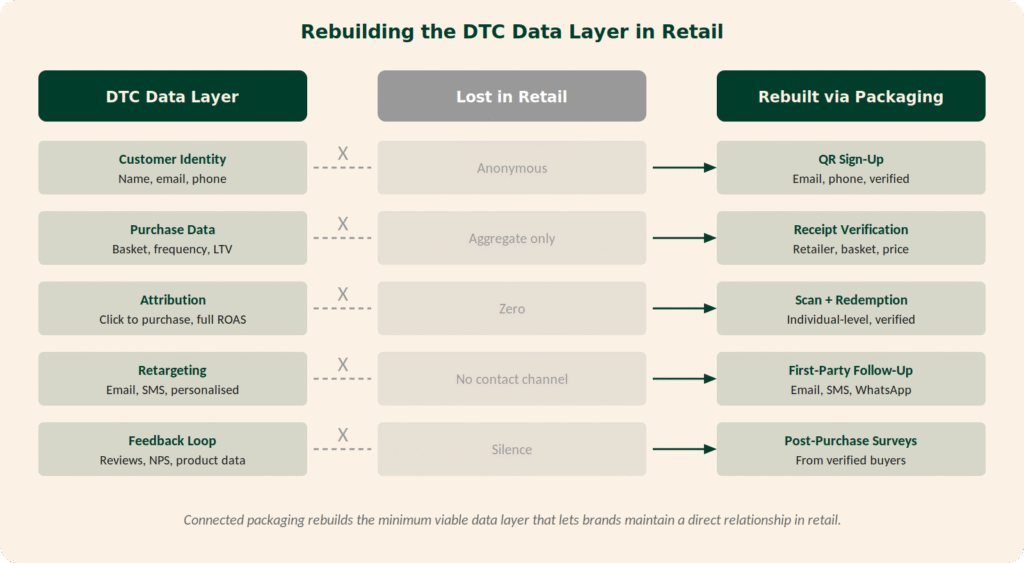
A brand puts a QR code on their product packaging. It’s not a static link. It’s a branded entry point into a connected experience that the brand owns and controls. When a customer buys the product and scans that code, they land in a branded environment. What they find there depends entirely on what the brand wants to achieve.
It might be a cashback reward that verifies their purchase via receipt upload. It might be a product education page where an AI agent answers their questions. It might be a short survey that captures preferences and feedback. It might be a loyalty programme sign-up. Or it might be all of these, sequenced intelligently.
Each of these interactions generates data. And critically, it’s data the brand owns directly. Not the retailer’s data. Not a panel provider’s sample. Not an ad platform’s approximation. The brand’s own first-party data from retail customers.
What PUREPOWER’s Campaign Tells Us About the Opportunity
PUREPOWER, an Irish sports nutrition brand, ran a connected packaging campaign through SeeGap. No cashback. No monetary incentive at all. Just a scan-and-survey mechanic on their product packaging. The results: 4,114 scans, 1,950 unique survey submissions, and approximately 1,100 consumer email addresses collected.
Before this campaign, PUREPOWER had zero direct relationships with their retail customers. They sold through retail stores and gyms across Ireland, and like every other FMCG brand selling through retail, the customer walked out the door and disappeared.
After one campaign, they had a database of verified purchasers they could email, survey again, retarget, and build a relationship with. No panel subscription required. No intermediary between the brand and the buyer.
Because this is an “always-on” campaign, these numbers only continue to increase each month for PUREPOWER
What makes this worth paying attention to isn’t just the numbers. It’s what the data represents. Every one of those 1,100 email addresses belongs to someone who actually bought PUREPOWER’s product, in a real store, with their own money. That’s not a lead from a paid ad. It’s not a website visitor who bounced. It’s a verified buyer.
What Can You Actually Do With This Data?
Fewer than 46% of businesses feel “very prepared” for marketing without third-party cookies (CookieYes, 2025). That number should worry any FMCG brand that’s been relying on programmatic targeting and retargeting to drive retail sales. But it also reveals the opportunity: the brands that build first-party data from retail now will be the ones who don’t need to scramble later.
Once you’ve captured post-purchase data from connected packaging, it works across three areas.
Retarget with intelligence. You know who bought, when they bought, and which retailer they bought from. You can send the right follow-up at the right time, through a channel the customer has already opted into. That’s not spray-and-pray advertising. It’s one-to-one communication with a verified buyer.
Feed insights back into product development. Survey responses from people who actually purchased your product are more valuable than panel estimates. When PUREPOWER asked buyers what flavours they preferred or how they used the product, those answers came from people with the product in their hands. That’s qualitative research at a fraction of the cost of traditional approaches.
Build a first-party data asset that compounds. Every campaign adds more verified buyers to the database. Over time, the brand accumulates a proprietary consumer intelligence layer that no competitor can replicate and no platform can take away. This is the asset that Byron Sharp’s research points to as structurally valuable: reach is more important than frequency, and first-party data from retail lets you reach the right people, not just more people.
How often do you hear a brand say they want to understand their retail customer better? This is how you actually do it. Not through another panel subscription or another retail media buy. Through your own product, your own packaging, your own data.
Book a Demo
If you’re putting QR codes on your packaging and sending people to a recipe page, you’re sitting on a data source and doing nothing with it. The brands getting ahead are using that same space to capture emails, verify purchases, gather insights, and build direct relationships with their retail customers.
[Book a 30-Minute Demo →] See what your packaging could actually be doing.