What DTC Brands Lose (and Need) When They Move Into Retail
Customer acquisition costs have risen 222% over the past eight years. For Direct-to-Consumer (DTC) brands specifically, 2025 brought a further 24.7% increase on top of that (Profitwell, 2026). The financial pressure is immense, reflected in the fact that more than half of publicly traded DTC companies have seen their stock price drop 50% or more since going public (Deloitte, 2025).
The pure-play DTC model is hitting its structural limits. Rising ad costs, crowded performance media, and the inherent inability of digital-only distribution to deliver sustained profitability at scale are pushing brands toward traditional retail. Glossier, Oura, Gymshark, Liquid Death, Vuori—some of the most successful DTC brands in the world—are all expanding into physical retail.
But here is what nobody talks about in the popular “DTC brands go omnichannel” narrative: When a DTC brand enters retail, it loses almost everything that made DTC work in the first place.
The customer data. The attribution. The feedback loop. The direct relationship. All of it disappears the moment a product lands on a retail shelf.
Key Takeaways
Rising Costs: CAC rose 222% over eight years, with DTC seeing a 24.7% spike in 2025 (Profitwell, 2026).
Stock Performance: Over 50% of public DTC companies have lost 50%+ stock value post-IPO (Deloitte, 2025).
Loss of Data: DTC brands own the full relationship (name, email, history, LTV); in retail, they own none of it.
The Solution: Connected packaging allows DTC brands to rebuild the critical data layer they lose in retail.
Why Are DTC Brands Moving Into Retail Now?
Customer acquisition costs across ecommerce increased approximately 40% between 2023 and 2025, driven by rising ad auction prices, privacy regulations reducing targeting precision (like iOS14+), and market saturation across major platforms (Phoenix Strategy Group, 2025). Meta’s cost per thousand impressions (CPM) hit an all-time high of $10.88 in Q1 2025, up 19.2% year-over-year (Varos/MobiLoud, 2026). For DTC brands built on paid social acquisition, the math is getting worse every quarter.
Three powerful forces are pushing this transition.
1. The economics stopped working. Digital customer acquisition is getting more expensive while returns diminish. The DTC share of total retail ecommerce has plateaued at around 19% (Swell, 2026). The easy growth phase is over. Brands that could once acquire customers profitably through Facebook and Instagram are now spending $68–$84 per customer on average, with luxury DTC brands hitting $175+ (Swell, 2026).
2. Consumers expect it. According to Deloitte’s Q1 2025 retail research, the initial novelty of DTC has waned. Consumers now expect to find their preferred products in the stores where they normally shop. A brand that exists only online increasingly feels like a brand that hasn’t “arrived” yet.
3. Retail gives you reach DTC can’t. Byron Sharp’s research is clear: physical availability is one of the two structural advantages that drive brand growth. Being on a shelf in Tesco, Dunnes, or SuperValu puts a product in front of thousands of shoppers who would never have seen it online. That’s reach you cannot buy through Meta at any price.
The move makes sense. The problem is what you lose in the process.
Explore: The Retail Attribution Gap →
What Do You Lose When You Move From DTC to Retail?
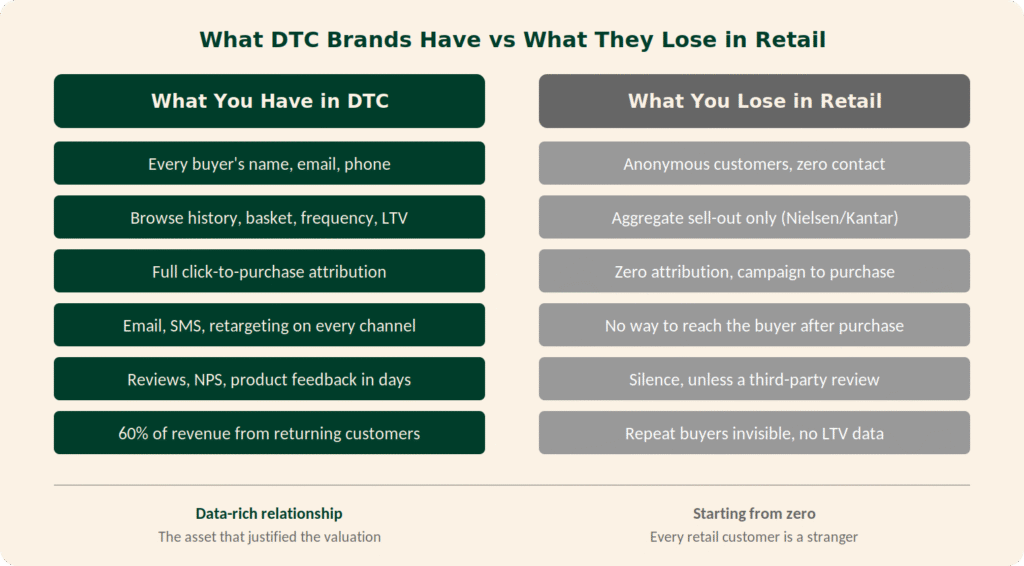
Sixty percent of DTC brand revenue comes from returning customers (EY/Swell, 2026). In DTC, that repeat relationship is visible, measurable, and actionable. In retail, it vanishes overnight.
Here’s what disappears the moment your product moves from your website to a retailer’s shelf.
Customer Identity In DTC, you know every buyer’s name, email, address, and phone number. In retail, the person who buys your product is completely anonymous. They walk in, pick it up, pay, and leave. You’ve never met them.
Purchase Data In DTC, you see browse history, basket contents, purchase frequency, average order value, and lifetime value. In retail, you get an aggregate sell-out figure from Nielsen or a sampled panel estimate from Kantar. No individual data. No purchase journey. No basket analysis.
Attribution In DTC, you can track every ad click through to purchase and calculate precise return on ad spend (ROAS). In retail, you might run a campaign that drives thousands of in-store purchases, but you cannot prove it. The purchase happens in a black box you cannot see inside.
Retargeting In DTC, you can email a customer who hasn’t bought in 30 days, send them a personalized offer, or retarget them across platforms. In retail, you have no way to reach the person who bought your product yesterday. They are gone.
The Feedback Loop In DTC, reviews, NPS scores, and product feedback are built into the experience. You know what people think about your product within days. In retail, you hear nothing unless someone leaves a review on a third-party site months later.
The Big Question
The shift to retail provides the physical availability necessary for scale, but it strips away the mental availability data (the “who” and “why” behind the purchase) that DTC brands rely on.
How do successful omnichannel brands rebuild that lost data connection? The answer lies in the product itself. Stay tuned for Part II.
Rebuilding the DTC Data Layer in the Retail “Black Box”
This is the gap nobody prepares for. DTC brands spend years building a data-driven customer relationship, only to move into retail and find they are starting from zero.
Why Can’t You Just Run Retail Like DTC?
The transition is jarring because the power dynamic shifts completely. In the digital world, the brand is the landlord; in retail, the brand is a tenant.
Sixty-two percent of shoppers say price now matters more than brand name (Ibotta/Supermarket News, 2026). In this environment, the DTC playbook of “own the customer and personalize everything” doesn’t translate. In retail, the retailer owns the customer.
-
The Retailer Owns the Shelf: they decide where your product sits, how it’s displayed, and if it gets promoted.
-
The Retailer Owns the Data: Loyalty programs like Clubcard, Dunnes Value Club, or SuperValu Real Rewards collect the purchase data that brands cannot access directly.
-
The Retailer Owns the Media: Retail media networks are the fastest-growing ad channel in grocery, and they are controlled entirely by the store.
The irony is sharp: DTC brands move to retail to escape rising Customer Acquisition Costs (CAC), but they trade that crisis for a data and attribution gap. You gain physical availability, but you lose the customer intelligence that made your DTC operation profitable in the first place.
The Founder’s Dilemma: DTC founders moving into retail consistently ask: “How do I maintain the data relationship I had online?” The honest answer is that you cannot replicate it through traditional retail mechanics. You have to rebuild it from the outside in.
Without a mechanism to capture first-party data from retail customers, a brand’s data advantage—the very thing that justified its venture valuation—erodes with every unit sold in-store.
How Connected Packaging Rebuilds the DTC Data Layer
According to GS1’s research, 79% of consumers are more likely to purchase products with a scannable QR code that provides additional information (GS1, 2026). The behavior is already mainstream; what matters is what the brand puts behind the code.
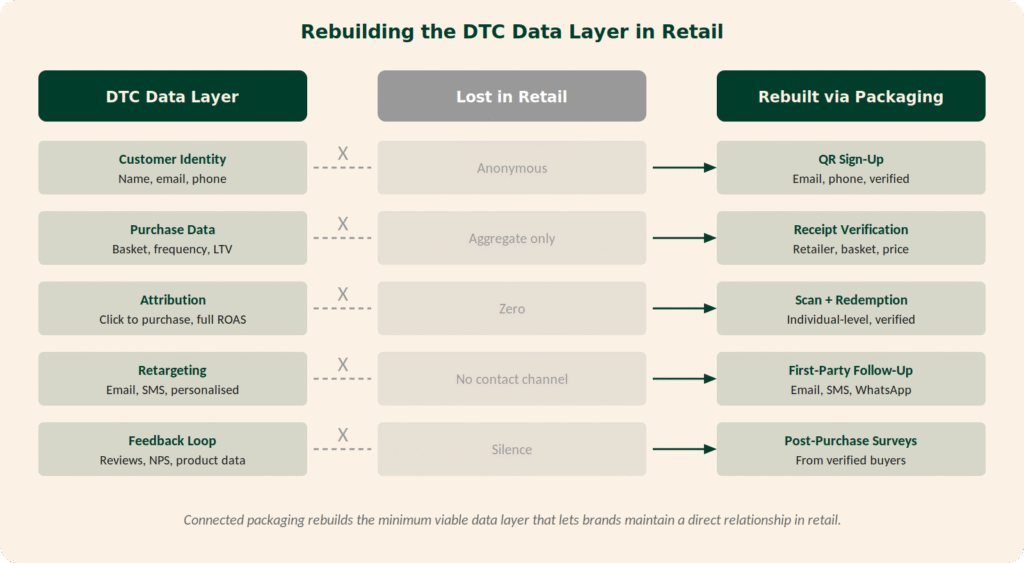
Connected packaging allows brands to systematically rebuild the intelligence layer that retail strips away:
| Lost in Retail | Rebuilt via Connected Packaging |
| Customer Identity | A QR scan leads to a sign-up flow capturing email/phone. The anonymous buyer becomes a known contact. |
| Purchase Data | Receipt verification captures which retailer, which products, and at what price. You get individual data, not samples. |
| Attribution | Every scan and cashback redemption is tracked. You can finally connect a specific digital campaign to an in-store purchase. |
| Retargeting | Captured first-party data enables Email, SMS, and WhatsApp follow-ups—re-engaging retail buyers just like DTC buyers. |
| Feedback Loop | Post-purchase surveys give you qualitative data (the “Why”) from people who actually bought the product in a real store. |
The New Hybrid Model
By using the physical product as the bridge, DTC brands don’t have to choose between scale and intelligence. They can have the massive reach of a supermarket shelf while maintaining the surgical data precision of a Shopify store.
The brands that win in the next five years won’t just be “omnichannel”—they will be the ones that successfully port their data DNA into the physical world.
Bridging the Gap: The Future is Unified Commerce
This isn’t about recreating the DTC experience in a supermarket aisle. Retail is a different beast with its own set of dynamics. However, the core asset that made your DTC brand valuable—a direct, data-rich relationship with the customer—doesn’t have to disappear the moment your product hits a shelf.
Connected packaging is the bridge that keeps your data DNA alive.
Deep Dive: Capturing first-party data from retail customers →
Why the Real Prize is “Unified Intelligence”
The most successful brands of the next decade won’t choose between DTC and retail; they will have both channels feeding a single customer intelligence layer. A consumer who buys from your website on Monday and picks up a refill at the grocery store on Friday should be one profile, not two “invisible strangers.”
-
DTC gives you Depth: Detailed browsing behavior, high-frequency purchase data, and direct feedback loops.
-
Retail gives you Reach: Massive physical availability and new customer acquisition in the environments where the majority of shopping still happens.
Connected packaging is the “glue.” When a customer who originally bought via your Shopify store scans a QR code in-store, the brand recognizes them. Their online and offline histories merge. This is the “Omnichannel” dream made real.
How it Fits the Marketing Science
Byron Sharp’s framework identifies Physical Availability as the reach lever and Mental Availability as the memory lever. Connected packaging ensures that the move into physical retail—your reach play—doesn’t come at the cost of the customer intelligence that powers your memory play.
Frequently Asked Questions
Why are DTC brands struggling with profitability?
Customer acquisition costs (CAC) have risen 222% over eight years, with a 24.7% spike in 2025 alone (Profitwell, 2026). Meta’s CPM hit an all-time high of $10.88 in Q1 2025 (Varos/MobiLoud, 2026). With DTC ecommerce share plateauing at 19% (Swell, 2026), the unit economics of digital-only growth are broken for many.
What data do you lose when moving to retail?
You lose “The Five Pillars” of DTC intelligence:
-
Identity (Email/Phone)
-
Individual Purchase Data (LTV/Frequency)
-
Attribution (What drove the sale?)
-
Retargeting (Direct re-engagement)
-
The Feedback Loop (Reviews/NPS). In retail, the customer is effectively a stranger.
Can Retail Media Networks (RMNs) replace the DTC data layer?
No. RMNs are retailer-controlled. You pay for exposure, but the retailer keeps the data, the audience, and the relationship. You get impressions, but you don’t get an email address or the ability to retarget outside their platform. Connected packaging is your own independent data channel.
Does this work alongside Shopify or Klaviyo?
Yes. Data captured via connected packaging in retail can feed directly into your existing CRM or email platform. A customer who buys via Shopify and then in-store is recognized as the same person, creating a unified view across all touchpoints.
Conclusion: Don’t Let Your Customers Walk Away as Strangers
The DTC model proved that a direct relationship with the customer is the ultimate competitive advantage. It justified valuations and made unit economics work.
Moving into retail shouldn’t mean surrendering that advantage. It simply means using different infrastructure to maintain it. The brands that treat the DTC-to-retail transition as a data problem, rather than just a distribution problem, will be the ones that win.
The product is on the shelf. The QR code is on the pack. Is your brand capturing the moment, or letting every retail customer walk away?
See It in Action
If you’re moving into retail or missing the data you had online, it’s time to build the bridge.