How QR Codes on Packaging Build Mental Availability (and Why Most Advertising Doesn’t)
Fewer than 20% of television advertisements are noticed and correctly attributed to the right brand. That finding, from decades of research at the Ehrenberg-Bass Institute, should give every marketer pause. The majority of money spent on advertising fails the most basic test: being processed by the consumer and linked to the correct brand.
Professor Byron Sharp argues that brand growth depends on two things above all else: mental availability and physical availability. Most marketing channels are surprisingly poor at building either.
-
A social media ad scrolled past in under nine seconds.
-
A billboard glimpsed from a car window.
-
An influencer post consumed alongside dozens of others.
These are passive, fleeting exposures that contribute weakly to memory structures. Connected packaging, however, is structurally different—and marketing science explains exactly why.
Key Takeaways
-
The Attribution Gap: Fewer than 20% of TV ads are noticed and correctly linked to the right brand (Ehrenberg-Bass Institute).
-
High-Impact Encoding: A single QR code interaction on packaging creates 6-8 distinct memory-encoding events vs. one fleeting moment from a typical ad.
-
Asset Reinforcement: Connected packaging reinforces distinctive brand assets at every step, in an environment the brand fully controls.
-
Zero-Party Data: Post-purchase surveys from verified buyers give brands individual-level Category Entry Point (CEP) data in real time.
What Is Mental Availability, and Why Do Most Impressions Fail to Build It?
The average social media user’s attention on a single post has dropped from 12 seconds in 2015 to 8.25 seconds in 2025 (SQ Magazine, 2025). In that window, a brand needs to be seen, processed, and correctly attributed. Most fail at all three.
Mental availability is not the same as awareness. Awareness is a blunt measure: “Have you heard of Brand X?” Mental availability is richer. It measures whether a brand comes to mind in specific contexts, occasions, and moments when a consumer is making a purchase decision.
The Science of Memory Networks
In the brain, brands exist as networks of memory associations. These networks are built through experience:
-
Seeing the product.
-
Encountering advertising.
-
Using the product.
-
Hearing someone mention it.
The more extensive and fresh these memory associations, the more likely the brand is to come to mind when it matters.
The Role of Category Entry Points (CEPs)
Sharp uses the concept of Category Entry Points (CEPs) to make this operational. CEPs are the specific needs, occasions, or situations that trigger a consumer to think about a product category.
A brand linked to more CEPs has higher mental availability.
Coca-Cola didn’t grow by being “differentiated” from Pepsi. It grew by building memory associations with lunch, celebrations, hot weather, movies, and countless other occasions.
The Marketer’s Dilemma
The practical question for any FMCG brand is this: how do you build richer, deeper, more lasting memory structures with the people who buy your products? If most advertising fails to clear even the attribution hurdle, where should you invest instead?
Why Does a QR Code Interaction Create Deeper Memory Structures Than an Ad?
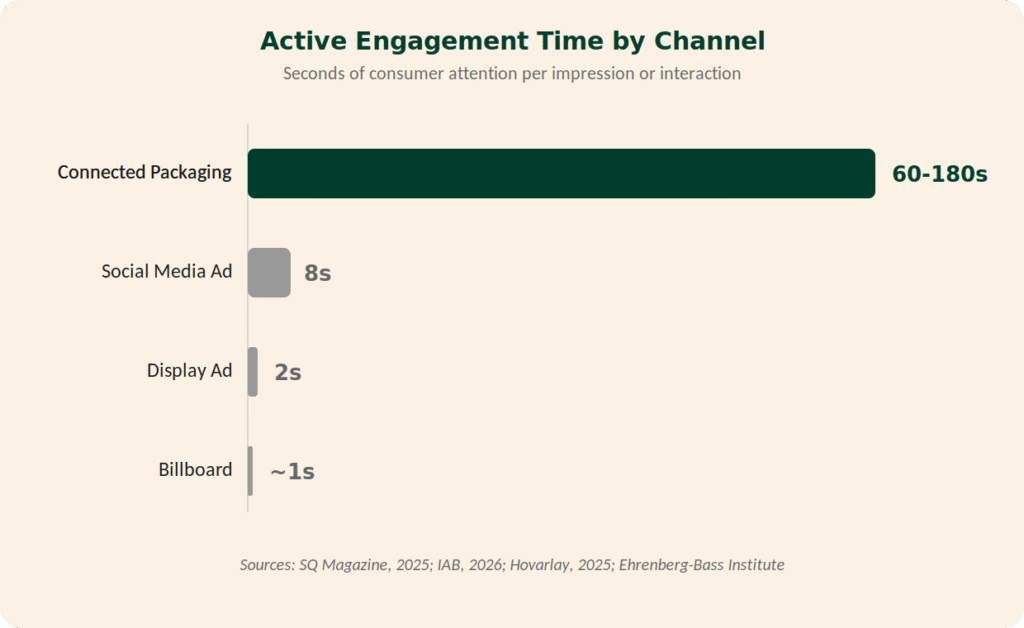
Food and beverage brands using QR codes on packaging see scan-to-engagement rates averaging 4-10%, with the best implementations reaching 25-30% (Uniqode, 2025). When consumers do engage, personalised QR content delivers 5.6x longer dwell time than standard landing pages (Hovarlay, 2025).
We are no longer talking about seconds of passive exposure; we are talking about minutes of active engagement.
Active vs. Passive: The Engagement Gap
Consider the fundamental difference between a standard ad impression and a QR code interaction on packaging.
The Standard Ad Impression (Passive)
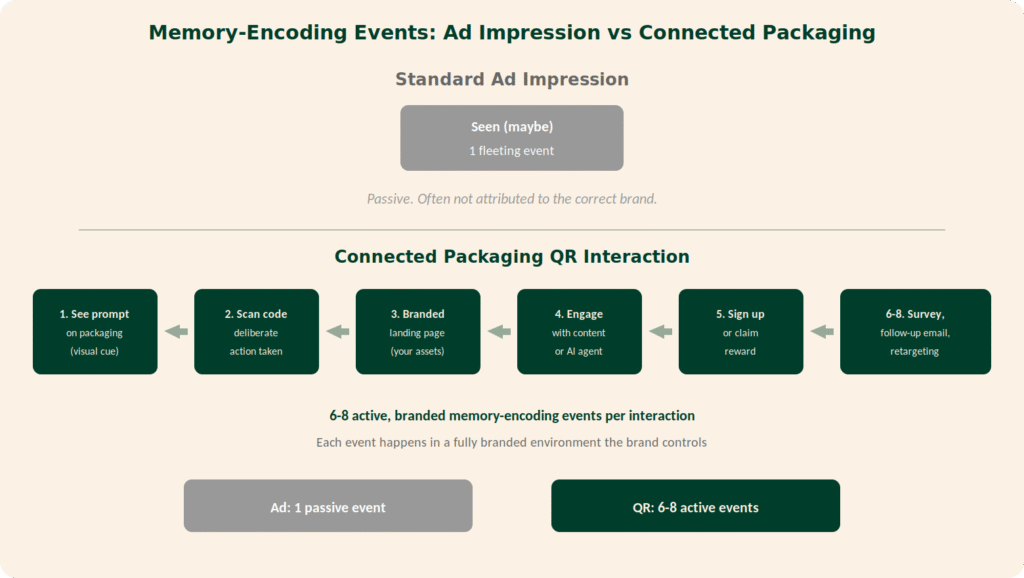
The consumer sees it (maybe), processes it briefly (maybe), attributes it to the correct brand (unlikely, per Sharp’s research), and moves on. This constitutes one fleeting memory-encoding event, if that.
The QR Code Interaction (Active)
The consumer is already holding the physical product. They have already made the conscious decision to engage. When they scan, they enter a branded ecosystem—whether it’s an offer page, an educational conversation, a survey, or a cashback claim.
The Core Difference: Each step in a connected packaging journey is a separate memory-encoding event, and critically, every single one happens within an environment the brand fully controls.
Mapping the Touchpoints: 8 Events in 1 Session
Count the individual touchpoints in a single connected packaging interaction. In one session, a consumer typically experiences:
-
Discovery: Seeing the QR code prompt on-pack.
-
Intent: The physical act of scanning.
-
Entry: Landing on a high-impact branded page.
-
Education: Reading about the product or interacting with an AI agent.
-
Conversion: Signing up or creating a profile.
-
Action: Completing a survey or claiming a reward.
-
Confirmation: Receiving an immediate on-screen success message.
-
Follow-up: Receiving a branded email or notification.
That is six to eight distinct memory-encoding events generated from a single purchase.
The Cognitive Science of “Self-Directed Learning”
Cognitive science tells us that active, self-directed learning produces far stronger memory formation than passive exposure.
-
Passive: Information is pushed at the consumer.
-
Active: The consumer asks questions, explores benefits, and chooses to interact.
A consumer who actively engages with branded content is encoding that information deeply. This isn’t a “seen and scrolled” moment; this is information that is engaged, processed, and remembered.
The Bottom Line for Brands
When we show brands the difference between a single passive ad impression and a connected packaging interaction mapped as a sequence of memory events, the reaction is immediate.
They stop thinking about QR codes as a “nice-to-have” digital add-on and start seeing them as their most underused brand-building asset.
Reinforcing Brand Assets & Mapping CEPs: The Science of Connected Packaging
Connected packaging creates the kind of deep, active memory encoding that Sharp’s research identifies as most effective for building mental availability. Crucially, it achieves this at the exact moment the consumer is physically holding the product.
How Do Distinctive Brand Assets Get Reinforced?
Influencer reels under 20 seconds generate 3.7x higher engagement rates, yet deliver only 12% brand recall (Sci-Tech Today, 2026). This creates a “high engagement, low attribution” trap—the very problem Professor Byron Sharp has warned about for years.
Sharp draws a critical distinction between differentiation and distinctiveness:
-
Differentiation: Making your product “meaningfully different” (often poorly perceived by consumers).
-
Distinctiveness: Using unique assets—colors, logos, shapes, characters, sounds, and slogans—to be easily recognized.
The Owned-Media Advantage
When a consumer scans a QR code on your product, the experience is entirely branded. Unlike retail media networks or coupon platforms where your identity is diluted by the retailer’s interface or competitor listings, a branded QR experience reinforces your assets at every step.
Case in Point: Mars brought back its M&M characters as “non-optional” assets, recognizing them as financial tools rather than creative devices. Connected packaging provides a controlled environment to deploy these assets consistently.
With 46% of marketers now using QR codes on packaging (Bitly, 2025), the winners are those designing fully branded journeys rather than just linking to a generic website.
What Can Connected Packaging Tell You About Category Entry Points (CEPs)?
PUREPOWER, an Irish sports nutrition brand, collected 1,747 unique survey submissions from verified purchasers through a on-pack evergreen campaign (SeeGap, 2025). Before this, they had no direct way to ask retail customers why or when they bought. After one campaign, they had individual-level answers.
Operationalizing Mental Availability
Sharp and Jenni Romaniuk’s CEP framework maps mental availability across seven dimensions:
-
Why (Motivation)
-
When (Time/Occasion)
-
Where (Location)
-
While (Activity)
-
With Whom (Social Context)
-
With What (Complementary Product)
-
How Feeling (Emotional State)
From Research Panels to Real-Time Data
Traditionally, mapping CEPs requires expensive agency research. Connected packaging offers a shortcut. When a buyer scans and answers a quick survey, the brand receives real-time CEP data from verified purchasers.
This creates a “living map” of the brand’s mental availability. It identifies which entry points drive trial, which are underserved, and where the “white space” for expansion exists. Most brands see QR codes as an activation tool; through Sharp’s lens, they are a CEP research engine.
The Compound Effect: Why It Gets More Powerful Over Time
QR code usage grew by 323% between 2021 and 2025 (Wave Connect/Barkoder, 2025). The behavior is now habitual, and its power lies in the long-term compound effect.
-
Immediate Impact: Deep, active memory encoding while the product is in hand.
-
Future Impact: First-party data enables retargeting, follow-up content, and seasonal prompts.
Each interaction is a new opportunity to strengthen memory structures and link the brand to new Category Entry Points. This is continuous, broad reach—not powered by expensive media buys, but by the brand’s own physical assets.
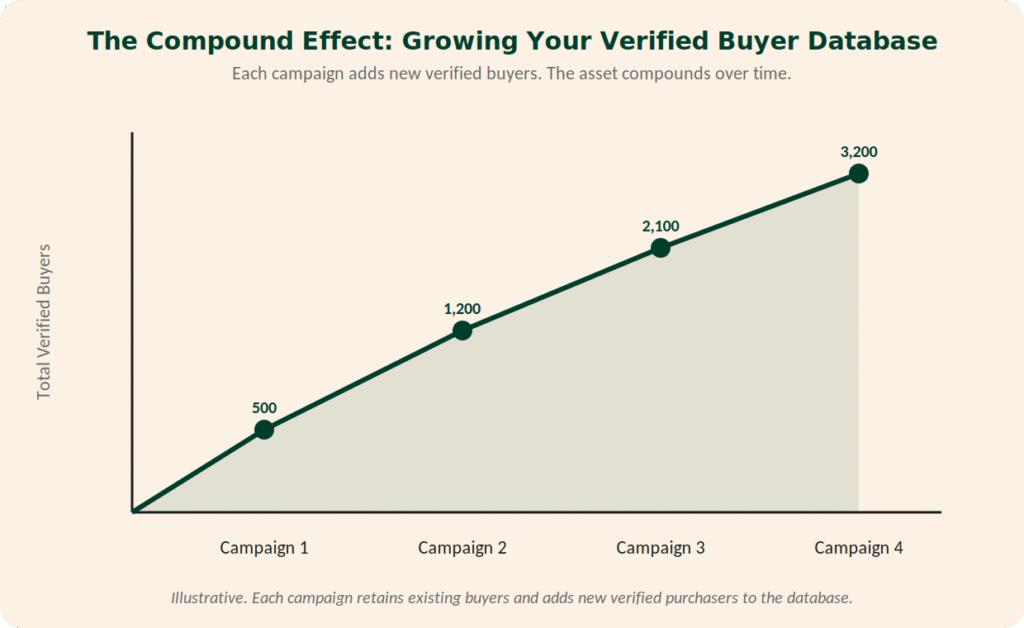
Every campaign adds more verified buyers to your database, building a proprietary intelligence layer that compounds with every single scan.
The Direct Line to Consumer Memory
The QR code on a product is not just a link to a webpage; it is a direct line to the consumer’s memory. The brands that use it intelligently—building distinctive, engaging, and data-capturing experiences—will be the ones that grow in an increasingly crowded marketplace.
See It in Action
If the goal is mental availability, we must ask which touchpoints actually build it. Most advertising creates a single, weak, passive impression. Connected packaging creates six to eight active, branded, and data-capturing memory events per interaction, in an environment you fully control.
[Book a 15-Minute Demo →] See how connected packaging builds the memory structures that traditional advertising can’t.
Frequently Asked Questions
What is mental availability and how is it different from brand awareness?
Awareness is binary: has someone heard of your brand or not? Mental availability is about whether the brand comes to mind in specific buying situations. A consumer might be aware of dozens of brands but only think of two or three when standing in the aisle. Research from the Ehrenberg-Bass Institute shows that brands with higher mental availability consistently outperform on sales, market share, and profit growth.
How many memory-encoding events does a typical QR code interaction create?
A single interaction typically creates six to eight distinct events:
-
Seeing the on-pack prompt
-
Scanning the code
-
Landing on the branded page
-
Interacting with content or an AI agent
-
Signing up
-
Completing a survey or claiming a reward
-
Receiving follow-up communication. Each event reinforces distinctive assets in a fully branded environment.
What are Category Entry Points (CEPs) and why do they matter?
CEPs are the specific situations, needs, or occasions that trigger a consumer to think about a product category. Developed by Jenni Romaniuk and Byron Sharp, the rule is simple: Brands linked to more CEPs sell more. For example, PUREPOWER collected 1,467 survey responses from verified purchasers in one campaign, providing individual-level CEP data that usually requires expensive panel research.
Can connected packaging work alongside traditional advertising?
Absolutely. Sharp’s framework doesn’t argue against advertising; it argues for building correctly attributed memory structures. Connected packaging complements advertising by adding depth. While an ad creates broad reach, the QR interaction deepens memory structures among actual buyers.
How does this apply to smaller brands with limited budgets?
This is where connected packaging is most valuable. Smaller brands cannot outspend giants on media, but they can create deeper memory structures per interaction. PUREPOWER generated 3,043 scans and 1,467 survey submissions with zero media spend beyond the packaging itself.
Conclusion
Byron Sharp’s research has been clear for over a decade: brands grow through mental and physical availability. Most marketing channels are failing at this—ads are fleeting, poorly attributed, and increasingly ignored as attention spans shrink.
Connected packaging changes the equation. It creates active, self-directed engagement at the moment a consumer is holding the product. It reinforces distinctive brand assets, captures first-party data, and turns every post-purchase survey into a powerful research tool.
The QR code on a product isn’t just a link. It’s a direct line to the consumer’s memory. The brands that use it intelligently will be the ones that win.
For further reading, Byron Sharp’s How Brands Grow and Jenni Romaniuk’s Building Distinctive Brand Assets are the foundational texts on these concepts, published by Oxford University Press through the Ehrenberg-Bass Institute.